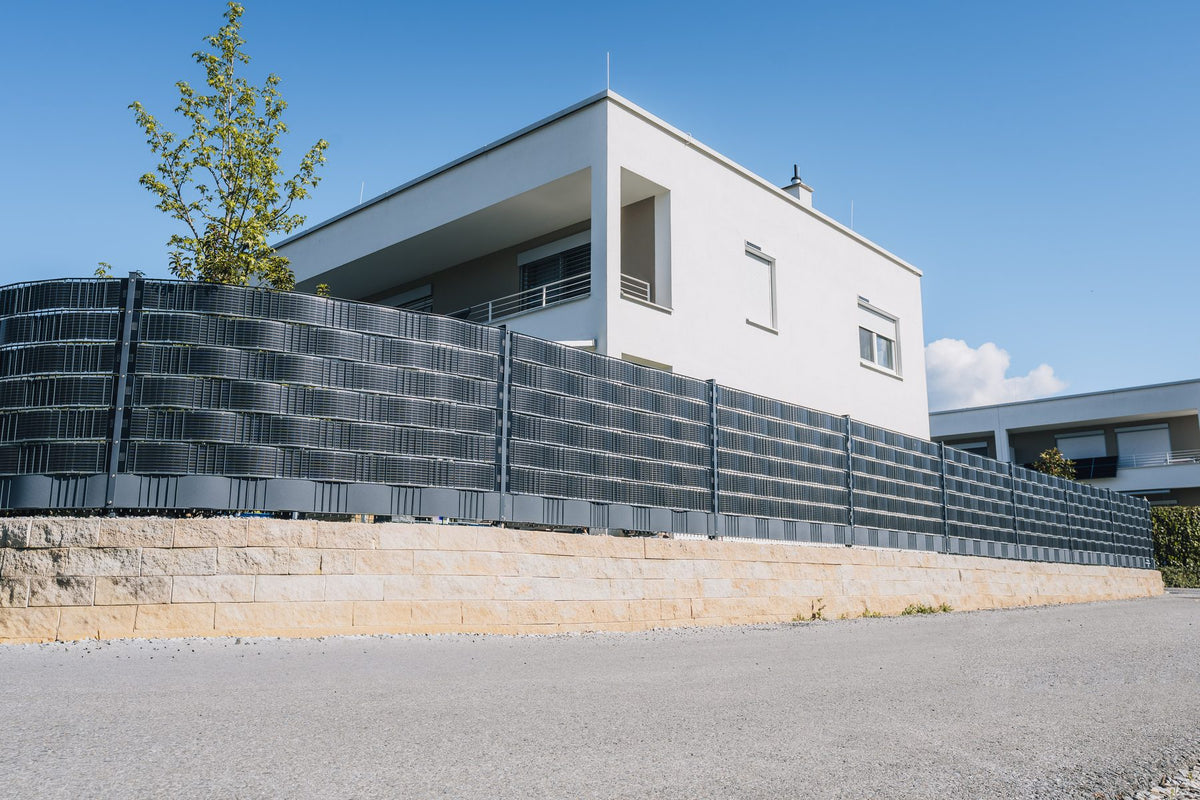
The following details come from the 3D view, where each part can be selected on the model.
Bifacial solar cell
The basis is a monocrystalline PERC cell in M6 format. It takes in light from both sides.
For the Sunbooster VERTICAL+ every cell is cut into four narrow quarter cells. 14 cells make the 56 quarter cells of a 2.5 m strip.
- Cell type
- Mono PERC, p-type, bifacial
- Format
- M6, 166 × 166 mm, 9 busbars
- Quarter cell
- 166 × 41.5 mm
- Cell efficiency
- 22.8 %
For installersA quarter cell carries only about a quarter of the current of a full cell, roughly 2.6 A. That keeps the losses in the cell connectors small.
Cell interconnection in the strip
In a 2.5 m strip, 56 quarter cells are connected in series; in the 2.0 m strip, 44. Nine cell connectors carry the current from cell to cell.
In a series connection the voltages add up while the current stays the same.
| Strip 2.5 m | Strip 2.0 m |
|---|
| Cells in series | 56 | 44 |
|---|
| Rated power | 83 Wp | 64 Wp |
|---|
| Voltage at MPP | 31.92 V | 25.08 V |
|---|
| Current at MPP | 2.62 A | 2.55 A |
|---|
| Open-circuit voltage | 37.52 V | 29.48 V |
|---|
| Short-circuit current | 2.73 A | 2.59 A |
|---|
Values at standard test conditions (STC): 1,000 W/m², 25 °C cell temperature, AM 1.5.
Glass-free laminate
Seven layers are pressed into one composite under vacuum and heat. On the outside, DuPont™ Tedlar® (PVF) protects both sides against UV light and weather.
Without glass the strip stays light and flexible. That is what allows it to be threaded through the fence.
- Structure
- PVF – EVA – PGF – cells – PGF – EVA – PVF
- Thickness
- 1.8 mm
- Dimensions
- 2,515 × 186 mm or 2,015 × 186 mm
- Weight
- approx. 1.2 kg (2.5 m) · 0.9 kg (2.0 m)
- Weight per fence panel
- about 7.2 kg for six strips
- Protection class
- IP67
- Warranty
- 20 years on the encapsulation
Junction box with protective diode
Each end of the strip has a junction box rated IP67. A Schottky diode works inside it.
The diode decouples the strip from its neighbours connected in parallel: if one strip is in the shade, no current flows back into it from the other five.
- Diode
- Schottky MBR20150CS, 20 A / 150 V
- Junction box
- approx. 86 × 30 × 20 mm, IP67
- Thickness at strip end
- 24.5 mm with box
Plus on the left, minus on the right
Seen from the connection side, every strip has the positive pole on the left and the negative pole on the right. The symbols are printed on the strip ends there.
When plugging the strips together the rule is always: plus to plus, minus to minus.
Frequently askedDo I have to install the next fence panel mirrored?
No. Every panel is threaded the same way: seen from the connection side, plus on the left and minus on the right. The connectors set the direction.
Which side faces where?
Both sides generate power. The side with the junction boxes and cables usually faces your property: there the cables are protected and the inverter is within reach.
For installersCheck the polarity of all plug connections before commissioning.
Threading into the fence
The strip is threaded into the double-wire mesh panel like a privacy strip: five bars in front of the fence, five bars behind it.
The fence bars hold the strip in place. No separate substructure is needed.
- Rhythm
- change sides every five fence bars
- Strip height
- 186 mm, fits the 200 mm mesh
- Installation
- two people, not in frost
Frequently askedHow does installation work?
You thread the six strips into the fence panel like a privacy strip, connect them and run the MC4 extension to the inverter. The installation video shows every step.
For installersRemove privacy strips from the rows that will hold the solar strips first. Depending on the fence type, the cover strips on the post are taken off for threading and screwed back on afterwards. Do not kink the strips.
Does it fit my fence?
Yes, if it is a double-wire mesh fence with panels 2.0 m or 2.5 m wide. That includes a fence that is already standing.
For the six strips the panel needs at least six rows. That is about 1.20 m in height.
- Wire gauges
- 6/5/6 mm and 8/6/8 mm
- Panel width
- 2.0 m or 2.5 m
- Fence height
- at least 6 rows, approx. 1.20 m
- Not suitable
- wooden, chain-link and round-bar fences
Frequently askedMy fence is lower or has fewer than six rows. What now?
A package always contains six strips. On a lower fence you spread them over several panels with extension cables, for example 3 + 3 on two panels. We do not recommend leaving strips out, because the inverter may then fail to start.
My fence is taller than 1.20 m. What happens to the remaining rows?
The six strips take up six rows. Remaining rows stay empty or get a privacy strip, like the bottom row in the model.
My post spacing is different, for example 1.85 m. Does that work?
The strips are available for panel widths of 2.0 m and 2.5 m. They cannot be shortened and must not be bent or led across a post. If in doubt, send us a photo of your fence.
Type A: the top strip
Type A forms the upper end of the fence panel. Its connectors lead downwards only; the top is closed with a cap.
A set always consists of one type A, four type B and one type C.
For installersInstallation starts in the top row with type A.
Type B: the four middle strips
Type B has connectors leading up and down. It links the rows to one another.
Every fence panel has four type B strips.
Type C: the bottom strip
Type C closes the fence panel at the bottom. The two MC4 cables lead from it to the inverter.
- MC4 cables
- 4 mm²
- Cable lengths
- plus 0.15 m · minus 0.50 m
For installersType C is installed last.
Parallel connection in the fence panel
The six strips of a fence panel are plugged together at both ends, from top to bottom: all positive poles on the left, all negative poles on the right.
In this parallel connection the voltage stays at around 32 volts while the currents of the strips add up.
| Fence panel 2.5 m | Fence panel 2.0 m |
|---|
| Rated power | 498 Wp | 384 Wp |
|---|
| Voltage at MPP | 31.92 V | 25.08 V |
|---|
| Current at MPP | 15.70 A | 15.31 A |
|---|
| Open-circuit voltage | 37.52 V | 29.48 V |
|---|
| Short-circuit current | 16.38 A | 15.54 A |
|---|
Values at standard test conditions (STC): 1,000 W/m², 25 °C cell temperature, AM 1.5.
Frequently askedSeries or parallel – and at what voltage?
Within a fence panel the six strips are plugged together in parallel. A 2.5 m panel works at around 32 volts; its open-circuit voltage is around 37.5 volts. That is extra-low voltage. Every 2.5 m fence panel gets its own input on the inverter.
For installersThe inverter input must be able to carry the short-circuit current of a whole fence panel: 16.4 A for the 2.5 m panel.
Both sides generate power
The cells are bifacial: front and back convert light into electricity.
A vertical fence therefore catches the morning sun on one side and the evening sun on the other.
- Yield guide value
- 815 kWh per kWp and year, measured in Graz
- Per 2.5 m panel
- about 410 kWh per year
Frequently askedWhat if my fence faces a different direction?
Because the strips work on both sides, almost any orientation fits. If the faces point east and west, you get power in the morning and evening; if they point south and north, mainly at midday.
What happens in the shade?
Shade from hedges or houses costs yield. The cells are interconnected in a way that makes partial shade matter less than with standard modules.
For installersA fence running north to south yields the most. Its faces then point east and west.
MC4 connection
The bottom strip has two MC4 cables, the standard connector in photovoltaics. MC4 extension cables lead from there to the inverter.
- Cross-section
- 4 mm²
- Cable lengths
- 0.15 m and 0.50 m
Frequently askedDoes the cable reach the socket?
The inverter has a 10 m connection cable for the socket. If it sits further away from the fence panel, you extend with additional MC4 cables.
For installersRoute the cables neatly along the horizontal bars and fix them with cable ties. There must be no strain on the plug connections.
Inverter, set and storage
The inverter turns the direct current of the fence into alternating current for the house.
Depending on its size, the Sunbooster VERTICAL+ works as a plug-in solar unit or as a three-phase PV system. The strips stay the same.
- Plug-in solar unit
- set of 1, 2 or 4 panels, up to 800 W, mains plug
- PV system
- three-phase with Hoymiles MIT-5000-8T, up to 8 fence panels per device
- Size
- a good 20 kWp on 100 m of fence
Frequently askedWhich set do I need?
Count your fence panels: one panel is the single system, two panels the double system, four panels the 4-panel system. For two panels choose the double system rather than two single systems, otherwise you end up with one inverter too many. For other numbers and long fences, the configurator on the product page works out all the parts.
Can I connect a battery?
Yes. In the sets with Jackery SolarVault 3 the strips connect directly to the battery, so no separate inverter is needed. You can connect up to four 2.5 m panels or up to eight 2.0 m panels. Other batteries, for example from Anker or EcoFlow, work if their solar input matches the low voltage of the strips.
Can I use my own inverter?
Yes, with the extension: six strips without an inverter. Your microinverter must be able to work with the low voltage of the strips. You will find this in its data sheet under MPPT range.
For installersWith string inverters every fence panel gets its own power optimiser. This keeps the voltage on the module side below 75 V DC.
800 W and registration
The plug-in solar unit connects to a normal socket with its mains plug. In Germany and Austria, plug-in systems may feed in up to 800 watts. Other countries have their own limits.
Longer fences are connected permanently as a PV system. An electrician takes care of that.
- Plug-in
- up to 800 W feed-in (Germany, Austria)
- Mains cable
- 10 m to the socket
Frequently askedI have a long fence. Can I go beyond 800 watts?
With a battery you can connect more panels: what you do not need right away is stored instead of given away. For long fences there is the permanently connected PV system with Hoymiles inverters, installed by an electrician. For fences longer than 10 m we are happy to prepare a quote.
Do I have to register it?
In Germany you only register a plug-in system in the Marktstammdatenregister, online and within a few minutes. In Austria you register the system with your grid operator. In other countries, please ask your grid operator.
For installersPermanently connected systems are installed by a qualified electrician, who also handles registration with the grid operator.
Every strip measured individually
Before shipping, every strip goes through a flash test. The serial number and a test certificate with the measured power are enclosed in the box.
- Performance warranty
- 20 years, at least 80 % of rated power
Frequently askedWhat warranty is there?
20 years performance warranty on the cells and on the Tedlar® encapsulation. The statutory two-year warranty applies to the rest of the product.